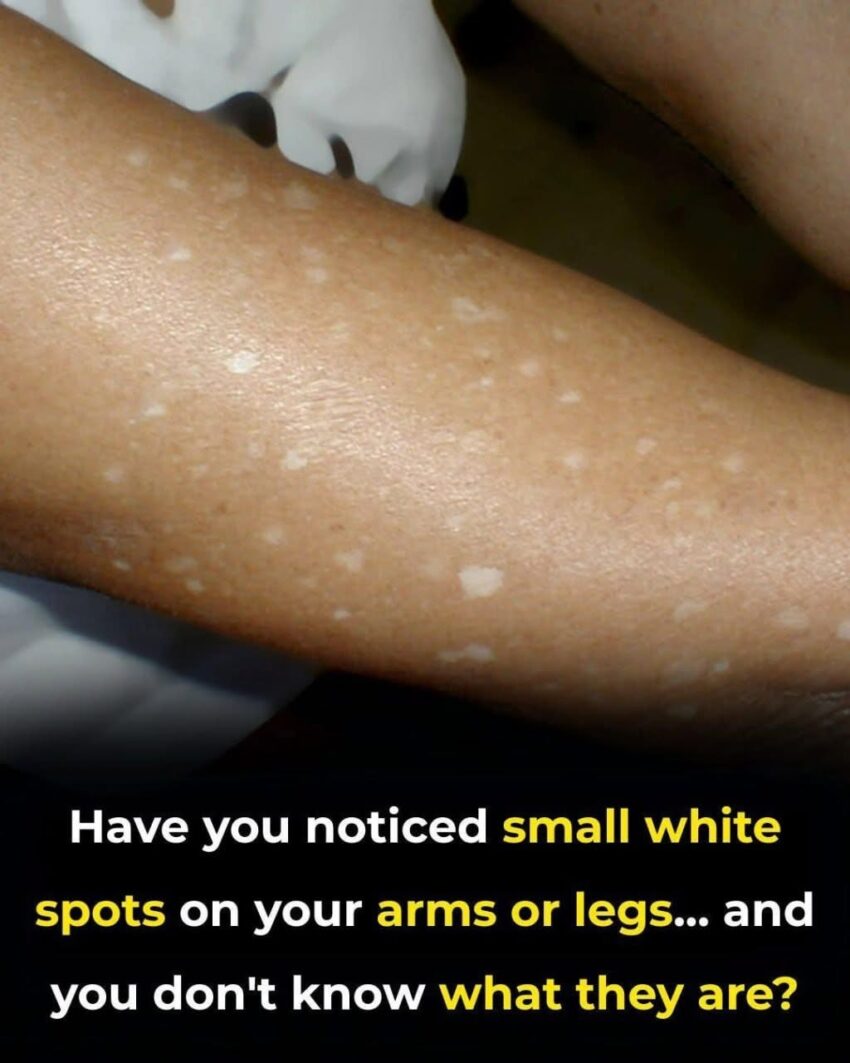
Have You Noticed Small White Spots on Your Arms or Legs… and You Don’t Know What They Are?
Small white spots on the arms or legs are quite common and can happen for many different reasons. While some causes are harmless and only affect appearance, others may need medical attention—especially if the spots are spreading, changing, or accompanied by other symptoms.
The appearance of the spots can provide clues:
- Are they flat or raised?
- Are they smooth or scaly?
- Are they spreading?
- Do they itch?
- Did they appear suddenly or gradually?
Common Causes of Small White Spots on the Skin
1. Sun-Related White Spots (Idiopathic Guttate Hypomelanosis)
One of the most common causes of tiny white spots on the arms and legs is:
Idiopathic guttate hypomelanosis
These spots are usually:
- Small (often a few millimeters)
- Flat
- Smooth
- More noticeable on sun-exposed areas
- Not painful or itchy
They are thought to be related to long-term sun exposure and natural changes in skin pigment cells.
They are usually harmless, but they may become more noticeable with age.
2. Vitiligo
Vitiligo is a condition where the immune system affects pigment-producing cells called melanocytes.
Signs may include:
- Clearly defined white patches
- Gradual spreading
- Symmetrical areas on both sides of the body
- White hair in affected areas in some cases
Vitiligo is not contagious and does not spread from person to person.
A healthcare professional can help confirm the diagnosis and discuss treatment options.
3. Fungal Skin Infection (Tinea Versicolor)
Tinea versicolor is caused by an overgrowth of a type of yeast that normally lives on the skin.
It may cause:
- Light or white patches
- Fine scaling
- Mild itching
- Spots on the chest, back, shoulders, or arms
The patches may become more noticeable after sun exposure because surrounding skin tans while affected areas do not.
4. Dry Skin or Eczema
Dryness can sometimes make areas of skin appear lighter.
Possible signs:
- Rough texture
- Flaking
- Mild redness
- Itching
Moisturizing regularly may improve mild dryness-related changes.
5. Post-Inflammatory Hypopigmentation
After skin irritation or injury, the affected area may temporarily lose some pigment.
Possible triggers:
- Scratches
- Burns
- Rashes
- Insect bites
- Skin inflammation
The color often gradually returns as the skin heals.
6. Nutritional Factors
Some nutrients are important for healthy skin, but small white spots are not usually caused simply by “a vitamin deficiency.”
Certain nutritional problems can affect skin appearance, but a proper evaluation is needed before assuming a cause.
When Should You See a Doctor?
It is a good idea to get medical advice if:
- White spots are spreading quickly.
- New patches appear suddenly.
- The spots involve the mouth, eyes, or genital area.
- There is itching, pain, swelling, or scaling.
- Hair turns white in the affected areas.
- The spots are changing in size or appearance.
- You are concerned or unsure of the cause.
What You Can Do at Home
Protect Your Skin From the Sun
Use:
- Broad-spectrum sunscreen.
- Protective clothing.
- Shade when possible.
Sun protection can prevent surrounding skin from becoming darker and making white spots more noticeable.
Avoid Harsh Skin Products
Strong chemicals and excessive scrubbing can irritate the skin and worsen uneven pigmentation.
Moisturize Regularly
A good moisturizer can help if dryness is contributing to a lighter appearance.
Myths vs. Facts
Myth: White spots always mean a serious disease.
Fact: Many causes, such as sun-related pigment changes or mild fungal conditions, are harmless and treatable.
Myth: White spots mean you are lacking calcium.
Fact: Calcium deficiency is not a common explanation for small white skin spots.
Myth: Vitiligo is contagious.
Fact: Vitiligo is an autoimmune condition and cannot be spread to others.
Key Takeaway
Small white spots on the arms or legs can come from several causes, including sun-related pigment changes, vitiligo, fungal infections, dry skin, or healing after inflammation. Most are not dangerous, but new, spreading, or changing spots should be checked by a healthcare professional to identify the exact cause and the best treatment.
