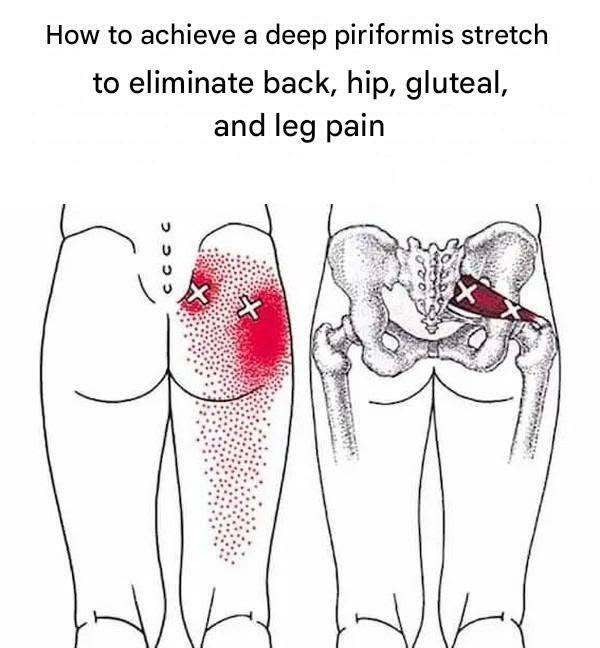
How to Achieve a Deep Piriformis Stretch to Help Relieve Back, Hip, Gluteal, and Leg Pain
The piriformis is a small, deep muscle located in the buttock, beneath the larger gluteal muscles. It runs from the sacrum (the triangular bone at the base of the spine) to the top of the femur (thigh bone). Its primary functions are to:
- Rotate the hip outward (external rotation).
- Stabilize the hip joint.
- Assist with movement of the leg during walking and running.
When the piriformis becomes tight or irritated, it can contribute to pain in the buttock and hip. In some people, it may also irritate the nearby sciatic nerve, leading to symptoms often referred to as piriformis syndrome. However, it’s important to note that not all back, hip, gluteal, or leg pain is caused by the piriformis. Similar symptoms can result from conditions such as a Lumbar disc herniation, Spinal stenosis, hip arthritis, or sacroiliac joint dysfunction.
A piriformis stretch can be a useful part of treatment if a tight piriformis is contributing to your symptoms, but it is not a universal cure.
Signs That a Tight Piriformis May Be Contributing
You may benefit from piriformis stretching if you have:
- Deep aching pain in one buttock.
- Pain after prolonged sitting.
- Stiffness in the hip.
- Discomfort when climbing stairs.
- Pain that radiates from the buttock down the back of the thigh.
- Tenderness over the buttock.
If you experience significant numbness, progressive weakness, loss of bladder or bowel control, or severe trauma-related pain, seek prompt medical evaluation rather than relying on stretching alone.
Warm Up Before Stretching
Stretching a cold muscle is less effective and may increase the risk of strain.
Before stretching:
- Walk for 5–10 minutes.
- March in place.
- Ride a stationary bike for a few minutes.
- Apply gentle heat to the buttock if it feels stiff.
Stretch 1: Figure-Four Stretch (Most Popular)
How to Perform
- Lie on your back.
- Bend both knees.
- Cross your right ankle over your left knee, forming a “4.”
- Thread your hands behind your left thigh.
- Gently pull your left leg toward your chest.
- Keep your shoulders relaxed.
- Stop when you feel a stretch deep in the right buttock—not sharp pain.
- Hold for 20–30 seconds.
- Repeat 2–4 times on each side.
Tip: To deepen the stretch slightly, gently press the raised knee away from your body while maintaining the pull.
Stretch 2: Seated Piriformis Stretch
This is convenient if you’re at work or traveling.
Steps
- Sit upright in a chair.
- Place one ankle across the opposite knee.
- Keep your back straight.
- Lean forward from your hips (not by rounding your back).
- Continue until you feel the stretch in the buttock.
- Hold for 20–30 seconds.
- Repeat 2–4 times per side.
Stretch 3: Supine Knee-to-Opposite-Shoulder Stretch
- Lie on your back.
- Bend one knee.
- Grasp the knee with both hands.
- Pull it gently toward the opposite shoulder.
- Avoid twisting your pelvis excessively.
- Hold 20–30 seconds.
- Repeat several times.
This variation targets the piriformis from a slightly different angle.
Stretch 4: Pigeon Pose (Advanced)
Borrowed from yoga, this provides a deeper stretch but may not be suitable for everyone.
Steps
- Begin on hands and knees.
- Bring one knee forward.
- Angle the shin comfortably in front of you.
- Extend the other leg behind.
- Keep your hips as level as possible.
- Stay upright or gradually lean forward.
- Hold for 20–60 seconds, breathing steadily.
If you have knee pain or significant hip arthritis, choose a gentler alternative.
Stretch 5: Standing Piriformis Stretch
- Stand facing a sturdy surface.
- Place one ankle across the opposite thigh.
- Bend the standing leg as though sitting back into a chair.
- Keep your spine neutral.
- Hold 20–30 seconds.
This option is helpful for people who have difficulty getting down to the floor.
Foam Rolling (Self-Myofascial Release)
Some people find additional relief with a foam roller.
How
- Sit on a foam roller.
- Cross one ankle over the opposite knee.
- Shift your weight onto the affected buttock.
- Roll slowly over tender areas.
- Spend about 30–60 seconds on each side.
Avoid rolling directly over the lower back or any area that causes sharp or radiating pain.
Tips for a Safe, Effective Stretch
- Stretch slowly—never bounce.
- Aim for a sensation of tension, not pain.
- Breathe normally throughout.
- Keep your spine in a comfortable, neutral position.
- Repeat consistently (most days of the week) rather than forcing a very intense stretch occasionally.
Common Mistakes
- Stretching aggressively until it hurts.
- Holding your breath.
- Twisting the lower back instead of moving through the hip.
- Rounding the back excessively during seated stretches.
- Trying to “push through” nerve pain.
Can Stretching Eliminate Back, Hip, Gluteal, and Leg Pain?
Stretching can help if tightness in the piriformis is one of the contributing factors. However, it is unlikely to eliminate all pain if the underlying cause is something else.
For example:
| Condition | Can Piriformis Stretching Help? |
|---|---|
| Piriformis tightness | Often yes |
| Piriformis syndrome | Often as part of treatment |
| Muscle overuse | Often yes |
| Lumbar disc herniation | Usually limited benefit |
| Hip osteoarthritis | May improve flexibility but won’t reverse arthritis |
| Sacroiliac joint dysfunction | May help if muscle tightness contributes |
Strengthening Is Also Important
For lasting improvement, stretching is often combined with strengthening exercises for:
- Gluteus maximus.
- Gluteus medius.
- Core muscles.
- Hip stabilizers.
Examples include:
- Bridges.
- Clamshells.
- Side-lying leg raises.
- Bird-dog exercises.
- Bodyweight squats (if tolerated).
Improving strength and movement patterns can reduce the chance that the piriformis becomes overworked.
When to Seek Medical Advice
See a healthcare professional if you have:
- Pain lasting more than a few weeks despite self-care.
- Severe or worsening pain.
- Persistent numbness or tingling.
- Leg weakness.
- Fever, unexplained weight loss, or recent significant injury.
- Loss of bladder or bowel control (this requires urgent medical attention).
Summary
A deep piriformis stretch can be a valuable part of managing buttock and hip pain when the piriformis muscle is involved. Effective options include the figure-four stretch, seated stretch, knee-to-opposite-shoulder stretch, standing stretch, and pigeon pose, performed gently after a warm-up and held for 20–30 seconds. For many people, combining stretching with hip and core strengthening, good posture, and regular movement provides better long-term results than stretching alone. If pain is severe, persistent, or accompanied by neurological symptoms, a medical evaluation is important to identify the underlying cause and guide appropriate treatment.
