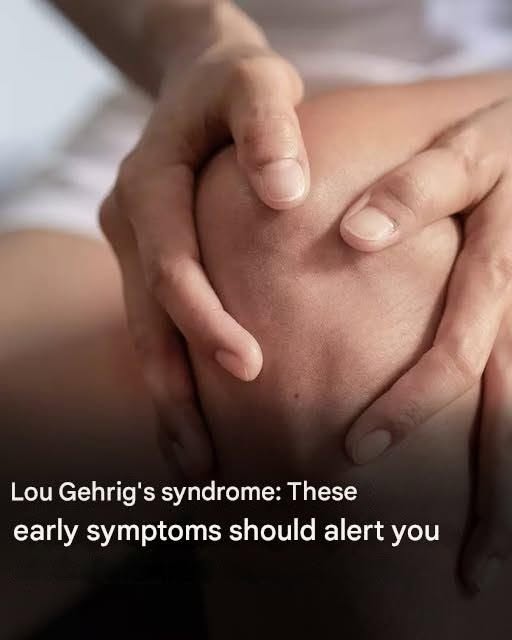
🧠 Lou Gehrig’s Disease (ALS): First Symptoms Explained Clearly
“Lou Gehrig’s disease” is the common name for Amyotrophic lateral sclerosis, a progressive condition that affects the nerve cells controlling voluntary muscles.
It slowly damages motor neurons in the brain and spinal cord, leading to muscle weakness over time.
👉 Important: Early symptoms are often subtle and easy to miss, and they vary from person to person.
⚠️ First Early Symptoms of ALS
1. 💪 Muscle weakness (most common early sign)
- Weakness in hands, arms, or legs
- Difficulty gripping objects
- Trouble lifting light items
- Feeling “clumsy” more often
👉 Example: dropping things frequently or struggling to turn keys.
2. 🚶 Difficulty walking or tripping
- Dragging one foot while walking
- Frequent stumbling
- Loss of balance
- Legs feeling “heavy”
This often starts on one side of the body.
3. ✋ Muscle twitching (fasciculations)
- Small involuntary muscle twitches
- Often in arms, legs, or tongue
- Can feel like tiny ripples under the skin
👉 This symptom is common but not always ALS-specific.
4. 🪶 Muscle stiffness or cramps
- Tight or stiff muscles
- Painful cramping
- Reduced flexibility
This happens as nerves begin to fail communication with muscles.
5. 🗣️ Speech changes
- Slurred or “thick” speech
- Difficulty pronouncing words
- Voice becoming softer or nasal
This happens when bulbar muscles are affected.
6. 😮 Swallowing difficulties
- Food or liquids feel harder to swallow
- Choking more easily
- Coughing during meals
This is a sign of muscle involvement in the throat.
7. ✍️ Hand coordination problems
- Trouble writing clearly
- Difficulty buttoning clothes
- Reduced fine motor control
🧠 Important medical reality
ALS is:
- Progressive (symptoms worsen over time)
- Motor-related only (does NOT usually affect memory or thinking early on)
- Variable in speed (some progress faster than others)
❗ What ALS does NOT usually cause early
To avoid confusion from viral posts:
- ❌ Sudden pain (not typical early sign)
- ❌ Numbness or tingling (usually points to other conditions)
- ❌ Vision loss
- ❌ Dizziness as a main symptom
These suggest other neurological or nerve issues instead.
🧪 Why early ALS is hard to detect
Early symptoms can look like:
- Simple weakness
- Aging-related fatigue
- Nerve compression
- Vitamin deficiency
- Overuse injuries
That’s why diagnosis usually requires:
- Neurological examination
- Electromyography (EMG)
- Imaging tests
🧠 When to seek medical attention
You should see a doctor if you notice:
- Persistent muscle weakness that worsens
- Repeated falls or tripping
- Ongoing muscle twitching with weakness
- Speech or swallowing changes
Early evaluation is important—not because ALS is common, but because other treatable conditions can mimic it.
📌 Key takeaway
👉 Early ALS symptoms usually involve:
- Muscle weakness
- Twitching
- Coordination problems
- Speech or swallowing changes
👉 It is a rare but serious neurodegenerative disease
👉 Many early symptoms can also be caused by much more common and treatable conditions
If you want, I can also explain:
- Early signs of ALS vs normal muscle weakness (easy comparison)
- Diseases that mimic ALS (very important for avoiding panic)
- Or how doctors actually diagnose it step by step
