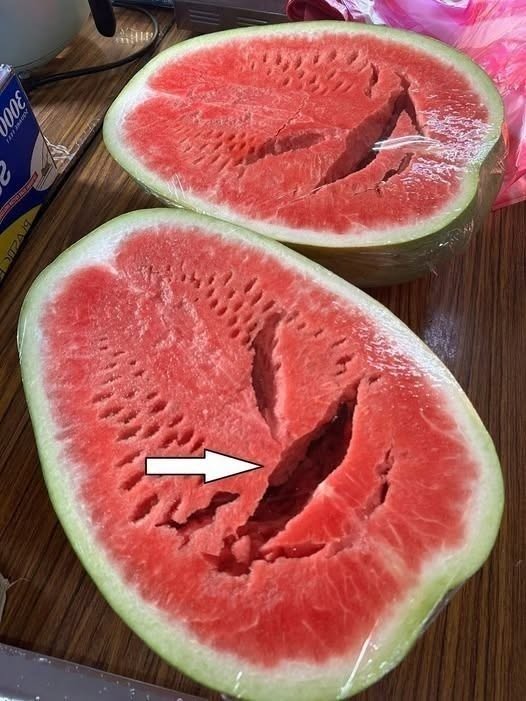
This is another viral fear-based food claim, and it’s not accurate in the way these posts usually present it.
Let’s break it down properly so you know what actually matters.
🍉 “Cracked watermelon inside” — should you panic?
No. Internal cracks in a watermelon are not automatically dangerous.
A watermelon with cracks or hollow-looking gaps inside is usually caused by natural or agricultural factors, not “poison” or immediate danger.
🔍 What those cracks actually mean
When you cut a watermelon and see:
- cracks in the flesh
- hollow spaces
- separation between parts
- grainy or spongy texture
it is usually due to:
1. Uneven growth (most common cause)
Watermelon grows fast under changing conditions:
- sudden rain after dry weather
- irregular watering
- rapid growth spurts
This causes the inner flesh to expand unevenly → leading to cracks.
2. Over-ripening
If left too long on the vine or stored too long:
- the flesh starts breaking down
- texture becomes soft or separated
- internal structure weakens
3. High nitrogen fertilizer use
Excess nitrogen can cause:
- fast growth of the fruit
- weak internal structure
- hollow or cracked flesh
This is an agricultural issue, not a poisoning issue.
4. Variety differences
Some watermelon types naturally have:
- softer flesh
- grainy texture
- internal separation
Not all watermelons are meant to be perfectly dense.
⚠️ When you SHOULD NOT eat watermelon
Cracks alone are NOT a danger sign, but you should avoid it if you notice:
❌ Bad smell
- sour
- alcoholic/fermented smell
❌ Slimy texture
- sticky or mushy flesh
❌ Mold growth
- white, black, or green fuzzy patches
❌ Fermentation signs
- fizzy taste or bubbling juice
These indicate spoilage.
🧠 Why viral posts say “stop eating immediately”
These posts are designed to:
- create fear
- get shares and clicks
- make normal food variations seem dangerous
They often mix:
- real facts (cracks exist)
- with false conclusions (“it’s toxic!”)
🍉 Is cracked watermelon safe?
✔ Safe:
- mild internal cracks
- slightly grainy texture
- uneven flesh
- no bad smell
❌ Not safe:
- sour smell
- mold
- slimy texture
- fermented taste
🧪 Health reality check
There is no scientific evidence that internal cracking in watermelon:
- produces toxins
- makes it poisonous
- indicates chemical contamination
It is mainly a quality issue, not a safety issue.
📌 Key takeaway
👉 A cracked watermelon inside usually means irregular growth or ripening, not danger.
👉 Only avoid it if there are true spoilage signs like smell, mold, or fermentation.
If you want, I can also explain:
- how to pick a perfectly sweet watermelon
- why some watermelons are red vs pale inside
- or signs of artificially ripened fruits (common confusion online)
